Red Light Panel Distance and Minutes: The J/cm² Maths
Last updated
Energy density (often called "dose") in J/cm² equals irradiance in mW/cm² multiplied by time in seconds, divided by 1,000. Because irradiance drops as you move away from a panel, the same number of minutes delivers less energy at 30 cm than at 15 cm, so you can only work out minutes once you know the irradiance at the exact distance you use.
The formula
J/cm² = mW/cm² × seconds ÷ 1000
And the reverse, to find time:
minutes = (J/cm² × 1000) ÷ (mW/cm² × 60)
Why ÷ 1000? Irradiance is in milliwatts (thousandths of a watt) per cm². One watt for one second is one joule. So mW × s gives millijoules, and ÷ 1000 turns that into joules.
Worked example
Say a panel delivers 40 mW/cm² at the spot where you sit, and you sit there for 10 minutes.
- 10 minutes = 600 seconds.
- 40 × 600 = 24,000 mJ/cm².
- 24,000 ÷ 1000 = 24 J/cm².
Reverse: to reach 10 J/cm² at 25 mW/cm²:
- 10 × 1000 = 10,000.
- 25 × 60 = 1,500.
- 10,000 ÷ 1,500 = 6.7 minutes (about 6 minutes 40 seconds).
These numbers show the arithmetic only. They are not recommendations.
Irradiance falls with distance
Move away from a panel and the light spreads over a larger area, so each cm² gets less. How fast it falls depends on the panel:
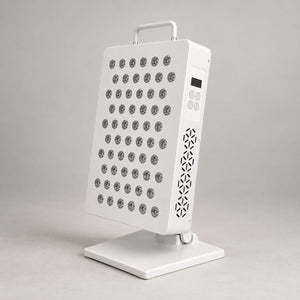
- Small panels behave more like a single point. Irradiance drops steeply, close to the inverse-square law (double the distance, about a quarter of the light).
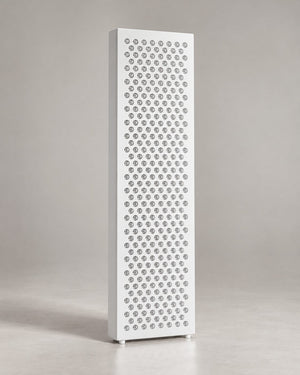
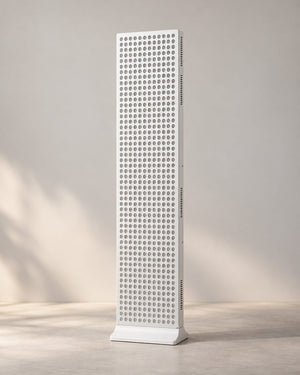
- Large panels are wide sources. Close up, light from many LEDs overlaps, so irradiance falls more slowly at first.
Published examples (each brand's own figures, seen October 2026):
| Device | Distance → irradiance | Who measured |
|---|---|---|
| Mychondria MyLight MOVE 2.0 (small) | 5 cm: 58.4 · 10 cm: 39.3 · 20.3 cm: 15.0 · 30.5 cm: 7.1 mW/cm² | Brand, spectrometer |
| Red Light Rising Target Light 670 | 20 cm: 55.96 · 30 cm: 33.40 mW/cm² | Independent measurement |
| Lichtblock Forte (large) | 15 cm: 74 · 90 cm: 54 mW/cm² | Brand, spectrometer |
Same minutes, different distance
Using the small-device figures above, 10 minutes (600 s) at each distance:
| Distance | Irradiance | Energy density in 10 min |
|---|---|---|
| 5 cm | 58.4 mW/cm² | 35.0 J/cm² |
| 10 cm | 39.3 mW/cm² | 23.6 J/cm² |
| 20.3 cm | 15.0 mW/cm² | 9.0 J/cm² |
| 30.5 cm | 7.1 mW/cm² | 4.3 J/cm² |
Moving from 5 cm to 30 cm cuts the energy by about 8 times for the same 10 minutes. That is why a minutes figure without a distance means little.
What you need to use the formula
- Irradiance at your distance. Measured, not calculated, and ideally with a spectrometer. A centre reading is higher than the average across the panel.
- The measuring instrument. Solar power meters can read high on red and near-infrared LEDs. See solar meter vs spectrometer.
- Which channels were on. Red only, near-infrared only and both together give different numbers.
What about Rubrawell panels?
We don't publish irradiance for Rubrawell panels yet. When our own measurements are done, we will publish values at 15, 30 and 45 cm for each size, so you can plug them into the calculator. Until then, follow the distance and time in your panel's manual. Manuals for this kind of panel commonly give 15–45 cm. We don't give health-based timing advice.
Sources
- Mychondria MyLight MOVE 2.0 distance figures: mychondria brand site, as published, seen Oct 2026.
- Red Light Rising Target Light 670 figures: redlightrising, as published, seen Oct 2026.
- Lichtblock Forte figures: lichtblock brand site, as published, seen Oct 2026.
- Formula: standard unit conversion (1 W = 1 J/s).
Last updated: 16 October 2026. The Rubrawell team.