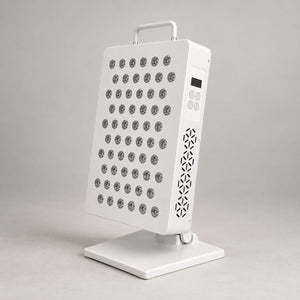
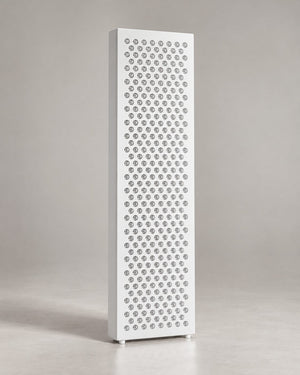
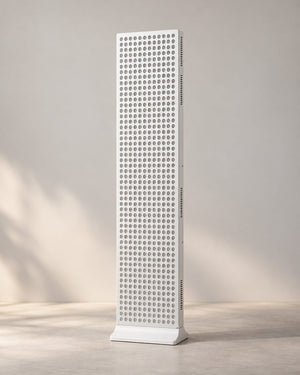
Red vs Near-Infrared: What 630, 660, 810, 830 and 850 nm Mean
Last updated
630 and 660 nm are visible red light; 810, 830 and 850 nm are near-infrared, just beyond what the human eye can see. A panel's wavelength list tells you which LED types it contains, but not how much light each one emits, so a panel with more wavelengths is not automatically stronger or better.
The five wavelengths on Rubrawell panels
Every Rubrawell panel uses these five LED types (manufacturer data):
| Wavelength | Band | Can you see it? | What it looks like |
|---|---|---|---|
| 630 nm | Red | Yes | Bright orange-red |
| 660 nm | Deep red | Yes | Deep red |
| 810 nm | Near-infrared | Barely or not at all | Very dim dark red glow, or nothing |
| 830 nm | Near-infrared | No | Looks off |
| 850 nm | Near-infrared | No | Looks off, or a faint red dot when you look straight at it |
By convention the visible spectrum runs from about 380 to 780 nm, and near-infrared (also called IR-A) from about 780 to 1,400 nm. The eye's sensitivity drops steeply above about 700 nm, which is why some LEDs on a panel seem dark when the panel is on.
What "nm" means
nm stands for nanometre, a billionth of a metre. It is the wavelength of the light: the distance between two peaks of the light wave. Shorter wavelengths look blue, longer ones look red, and longer still are infrared.
An LED labelled "660 nm" doesn't emit only 660 nm. It emits a band around a peak, typically a few tens of nanometres wide. The width is given as FWHM (full width at half maximum). That means 830 and 850 nm LEDs overlap a lot.
Why more wavelengths isn't better by itself
Some panels advertise 7 or 9 wavelengths. The count alone tells you little:
- Power is shared. A panel has a fixed number of LEDs and a fixed power budget. Adding channels usually means fewer LEDs per channel.
- Neighbouring bands overlap. With FWHM of a few tens of nanometres, 830 and 850 nm cover much of the same range.
- The label is not a measurement. Only a spectrometer reading shows the real peak of each channel. A "660 nm" LED can peak at 640 or 680 nm.
- Irradiance per channel matters more. How much light each band delivers at your distance is the useful number, not how many bands are listed.
What to ask any seller: a spectrum plot with peak wavelength and FWHM per channel, and irradiance at a stated distance with red only, near-infrared only and both on.
Visible vs invisible: why it matters for your eyes
Your eyes react to bright visible light: the pupil narrows and you look away or blink. Near-infrared doesn't trigger that response because you can't see it. So a panel can be sending out a lot of near-infrared while looking dim. Don't stare into any panel, and use goggles or close your eyes. More in eye safety basics.
Sources
- Visible and infrared range definitions: CIE / ISO 20473 spectral band conventions (visible about 380–780 nm, IR-A 780–1,400 nm).
- Wavelengths of Rubrawell panels: manufacturer listing (Shenzhen manufacturer), Oct 2026.
Last updated: 16 October 2026. The Rubrawell team.