Red Light Panel Eye Safety: The Basics
Last updated
Don't look straight into the LEDs of a red light panel, and close your eyes or wear protective goggles during use. Near-infrared light is invisible, so your eyes don't squint or turn away from it the way they do from bright visible light; that is the main reason goggles matter more with red + near-infrared panels than with an ordinary lamp.
Five basic rules
- Don't stare into the LEDs. Face the panel with your eyes closed, or look away.
- Wear goggles made for these wavelengths if you want your eyes open, especially close to the panel.
- Remember near-infrared is on even when it looks dark. LEDs at 830 and 850 nm can look off while emitting.
- Keep to the distance and time in the manual. Closer means more light.
- Keep children and pets from staring at the panel, and switch it off when not in use.
If you have an eye condition or take medication that makes you sensitive to light, ask your doctor before using any bright light source.
Why near-infrared needs extra care
Your eye protects itself from bright visible light with the aversion response: you blink, squint or look away within about a quarter of a second, and the pupil narrows. Near-infrared light (780–1,400 nm) doesn't trigger this, because the retina's light-sensing cells barely respond to it. So the brightness you see is not a guide to how much near-infrared reaches your eyes.
IEC 62471 risk groups, explained
IEC 62471 (EN 62471 in Europe) is the standard for the photobiological safety of lamps and lamp systems, including LEDs. A lab measures the light at set distances and assigns a risk group:
| Risk group | Meaning under the standard |
|---|---|
| Exempt (RG0) | No photobiological hazard under the standard's test conditions |
| RG1, low risk | No hazard under normal behavioural limits of exposure |
| RG2, moderate risk | No hazard because people naturally turn away from bright light or heat discomfort |
| RG3, high risk | Hazardous even for brief exposure |
The standard assesses several hazards separately, including retinal blue-light, retinal thermal, infrared hazard to the cornea and lens (780–3,000 nm), and skin thermal. A risk group only means something together with the report: which model, which mode (red, near-infrared or both), at what distance and for how long.
What to ask any seller: the full EN/IEC 62471 report for the exact model, the lab that issued it, the risk group per mode and the distance it applies to. CE marking alone doesn't tell you the risk group.
What about Rubrawell panels?
We haven't published a risk group for Rubrawell panels. We will only state one once we hold an EN 62471 test report for each model and have verified it with the issuing lab. Until then, follow the five rules above.
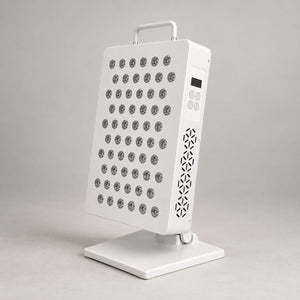
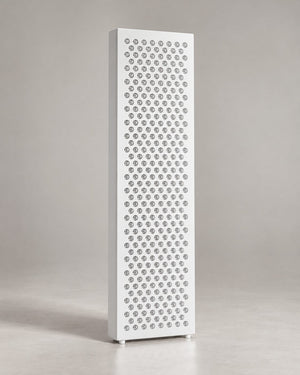
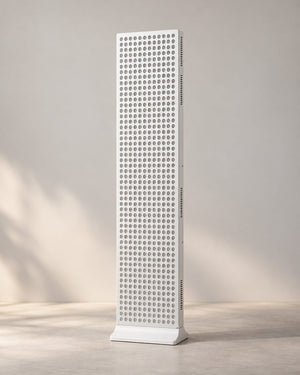
The Rubrawell Half and Full come with protective goggles in the box, per the manufacturer's accessory list. The Rubrawell Desk doesn't include goggles, so Desk owners should use goggles that block the 600–1000 nm range, which covers all five wavelengths of our panels (630, 660, 810, 830 and 850 nm).
Choosing goggles
- Look for published transmission or optical density (OD) data at the panel's wavelengths, here 630 to 850 nm.
- Sunglasses are not a substitute: many block visible light but pass near-infrared.
- Wrap-around fit stops light from the sides.
- Clear "blue light" glasses don't block red or near-infrared.
Sources
- IEC 62471:2006 / EN 62471:2008, Photobiological safety of lamps and lamp systems (risk groups and hazard types).
- ICNIRP guidelines on limits of exposure to incoherent visible and infrared radiation (2013).
- European Commission, information on risk groups of light sources.
Last updated: 16 October 2026. The Rubrawell team.